
A good video ad starts not with the camera, but with three decisions: where it will be shown, how many seconds you have and what the viewer should do after watching. If you need a video made from start to finish, from idea to final edit, see how our production works, and browse finished work in our portfolio.
Platforms and their requirements
Television
- Goal: mass reach in a short time, image building, the backbone medium of the whole campaign.
- Length: usually 15–30 seconds.
- What matters: a consistent visual style, an offer that reads even from a sofa on the other side of the room, and a 2–3 second packshot at the end.
YouTube
- Goal: reach plus measurable actions thanks to end-to-end analytics.
- Formats: skippable in-stream ads, in-feed (formerly Discovery), short clips.
- Length: 6 seconds for bumpers, 15–30 for in-stream, up to a minute for short vertical videos.
- Script: a gripping opening in the first 2–3 seconds, brand and offer as early as possible, subtitles are a must.
Instagram: feed, Stories, Reels
- Goal: grab attention instantly and trigger a response.
- Length: Stories 10–15 seconds, Reels 15–30.
- Techniques: vertical framing, close-ups, text overlays, fast editing.
TikTok
- Goal: broad reach and quick testing of creative ideas.
- Length: 6–20 seconds with nothing superfluous, up to 30 if there is a storyline.
- Techniques: natural, “live” footage in the platform’s style, a series of videos instead of a single one.
How a short video is built
Almost any 15-second ad can be assembled from five parts:
- Hook, 0–3 s. A strong shot, an acute problem or an unexpected figure: something that stops the thumb.
- Benefit, 3–8 s. How the product solves the problem. One or two benefits, no more.
- Proof, 8–12 s. The product in action, reviews, facts.
- Call to action, 12–15 s. A specific action: order, sign up, get a consultation.
- Packshot, 2–3 s. Logo, website or address, a short offer.
Editing tips. Keep the pace slightly faster than feels comfortable, especially for mobile feeds. Make cuts based on meaning, not the stopwatch. Always produce a subtitled version: a large share of social media video is watched without sound.
What makes up the budget
Small project: tests and local campaigns. A 15–30 second script, a technical brief, one location. One shoot day, one camera, basic lighting, one or two actors, a few scenes. The output is the main video and a couple of variations with different hooks or in different formats, vertical and horizontal cuts, subtitles and colour grading.
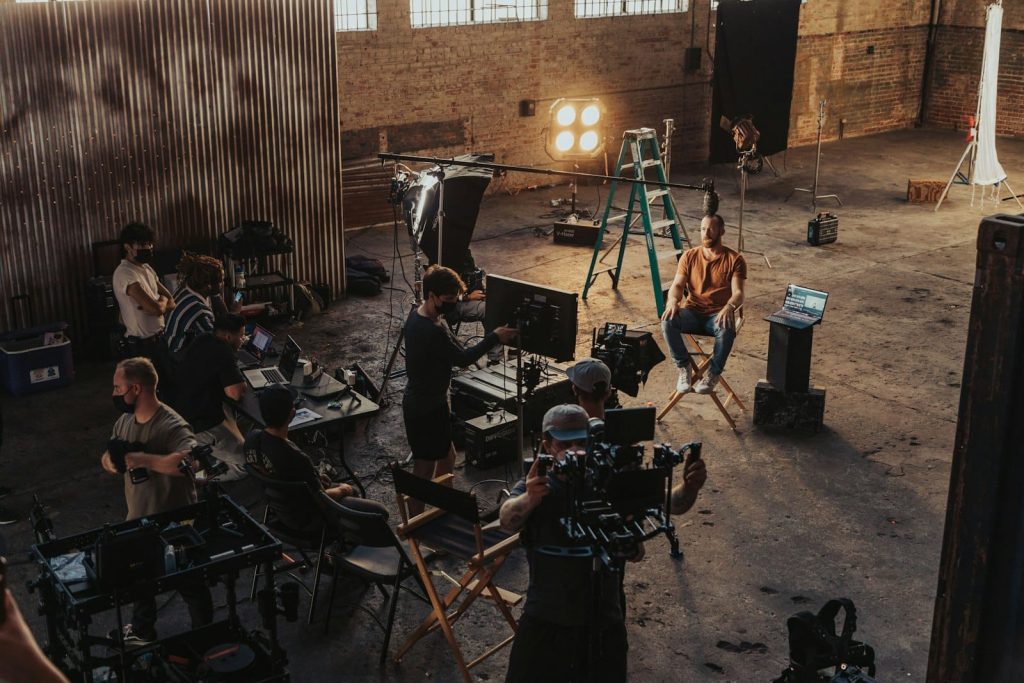
Mid-level: a city or region, a rotation of a couple of months. Storyboard, casting, several locations. One or two shoot days, two cameras, lighting, a sound engineer, a Steadicam, a producer. Editing of 15 and 30 second versions, a shortened six-second cut, graphics, sound design, platform adaptations. The result is a package of several videos.
Large project: national reach and an image campaign. Concept, references, music, a production designer. Several shoot days, complex locations or a studio, actors, and VFX and CGI if needed. Extended graphics, mastering for TV and digital, versions for outdoor screens and cinemas. The result is a set of brand assets and a series of videos.
Shoot days usually cost the most, but it is not worth cutting corners on preparation and post-production.
What to include in the brief
- Goal: awareness, enquiries, sales or a promotion launch.
- Audience: who these people are, what language they speak, what matters to them.
- Key message: fits into one sentence.
- Scenes: a few key moments of the storyline.
- Platforms and length: where it will be shown and how many seconds you need.
- Mood and examples: two or three “we want it like this” videos.
- Rights: music, images of people, locations, term and territory of use.
- Deadlines and success criteria: by what date the video is needed and how the result will be judged.
Preparing for the shoot day
- A shot list with timings for each scene.
- A script rehearsal, approved costumes and props.
- A backup plan in case of bad weather or an actor being replaced.
- Separately filmed close-ups and details for dynamic editing.
- Takes in both vertical and horizontal formats, so you do not have to crop the frame later.
- Clean sound from a lavalier or shotgun microphone, with background noise under control.
- A copy of the footage in at least two places immediately after the shoot.
Frequently asked questions
Can one video work for all platforms?
It is better to plan a set of versions from the outset: a six-second teaser, a main 15–20 second video and a 30-second version for TV and YouTube.
Which matters more, the idea or the quality of the shoot?
The idea. No equipment can rescue an empty creative, but sound, lighting and editing must also be seamless.
When should you choose animation?
When the product is hard to show live, when you need to explain a process or figures, or when the video will have to be updated often without reshooting.
Planning a video ad? Send us a brief, and SKY Central Asia will prepare an estimate and a work schedule. Find out more on the video production page and in the production and BTL section.

Leave a comment