
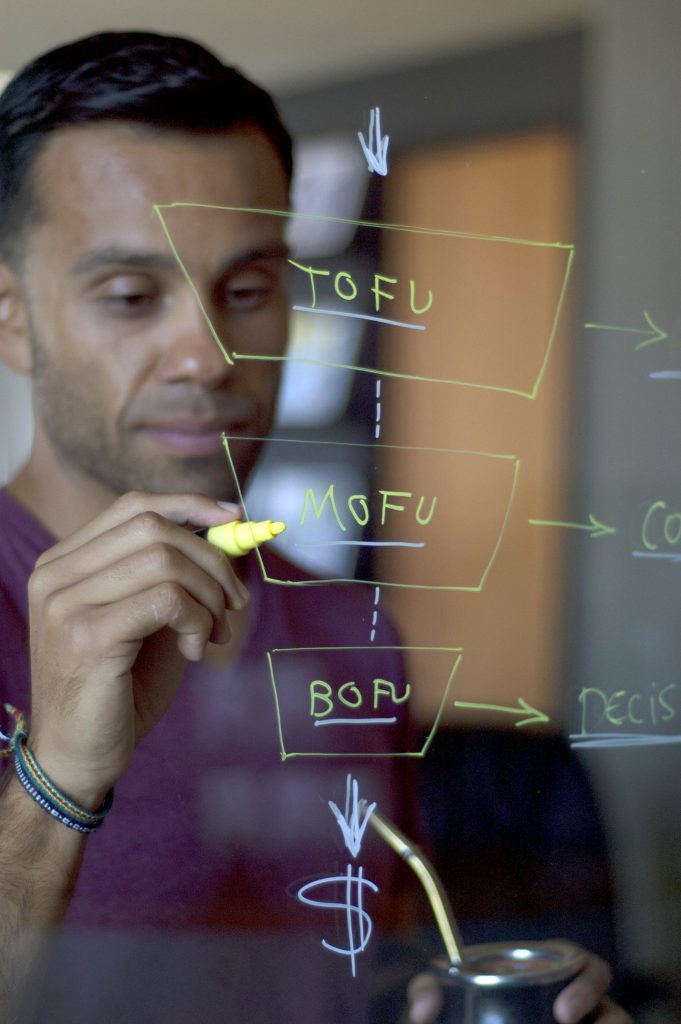
The video has racked up views, banners hang all over the city, and yet the phone in the sales department rings no more often than usual. That means the advertising creates interest, but people have nowhere to go next. The solution is to map the customer journey in Tajikistan as a whole, from first acquaintance to repeat purchase, and for each stage define what the person sees, where they go next and how to measure it.
Four stages and their tasks
1. Awareness
The person hears about you for the first time. Video, outdoor, radio and high-reach posts work here.
2. Consideration
The customer compares you with alternatives. Landing pages with explanations, comparisons of options, reviews and short customer stories help.
3. Action
Getting in touch should take minimal effort: a short form, a messenger button, a call with call tracking, a basket on the website or a till in the shop.
4. Loyalty/Repeat
The task is to get the customer to come back: email newsletters, retargeting, a loyalty programme, personalised offers.
The rule that ties the whole chain together: after every touchpoint, the person should have exactly one obvious next step. A QR code leads to the promotion page, a video to a consultation booking form, a call to a customer record in the CRM.
What content each stage needs
| Stage | First seconds of contact | What to show in more detail | What to avoid |
|---|---|---|---|
| Awareness | One customer problem and one benefit | A creative or short video where the product is clearly visible | A striking image that does not make clear what is being sold |
| Consideration | A couple of strong arguments | Comparisons, reviews, a customer story, answers to frequent questions | A wall of text and professional jargon |
| Action | A clear call to action, price and terms | A short form or chat, payment and delivery options | Multi-step questionnaires, terms in small print |
| Loyalty | Thanks or a bonus for a repeat visit | Message sequences, offers based on purchase history | The same newsletter to the whole list |
For video: a hook right away, subtitles without fail, vertical format for feeds.
Channels and their place in the funnel
- Video advertising — awareness and consideration, quick testing of messages.
- Search and performance advertising — action: it catches those who are already looking for where to buy.
- Outdoor and radio — awareness and frequency.
- Messengers and phone — action: many people find it much easier to message on WhatsApp or Telegram than to fill in a form.
- Shop and till — action and loyalty: promo codes, loyalty cards, post-purchase messages.
An example chain for retail: billboard with a QR code → mobile page with a “pick it up today” offer → retargeting to those who opened it → coupon at checkout → message with a bonus for the next purchase.
Attribution without endless arguments
To avoid arguing for months about which channel brought the sale, choose your models in advance:
- Last-Click — all the credit goes to the last touchpoint; convenient for day-to-day monitoring of enquiries.
- Position-based (40/20/40) — more weight to the first and last touchpoints; suitable when a campaign has a lot of display advertising.
- Data-Driven and experiments — when there is enough data: geo-tests with control areas, sales uplift measurements.
Keep two reports: a strict one based on last click and a fair one based on the position model. Move budget where their conclusions agree.
Weekly dashboard: which metrics to track
- Awareness: reach and impressions, contact frequency with the core audience, video view-through rate (VTR), banner CTR.
- Consideration: time on page, scroll depth, clicks on comparisons and FAQ answers, taps on messenger and call buttons.
- Action: click-to-enquiry or click-to-purchase conversion (CVR), cost per lead and per customer (CPL/CAC), sales confirmed in the CRM, branded searches, ROAS/ROI.
- Loyalty: repeat purchases and visits, what share of the list receives communications, revenue per customer.
Technically, this rests on a single UTM tagging scheme, dynamic number insertion (DNI), uploading offline conversions to the ad accounts and notes on changes to prices, creatives or landing pages.
A hypothetical scenario: home services in Dushanbe
Suppose a home services company has good reach but few enquiries. A logical plan: a short video plus an ultra-short version; a landing page where the price and timing are visible straight away, with answers to questions below; WhatsApp and call buttons plus a simple quiz; a repeat-order coupon sent via messenger. The result is assessed using the dashboard metrics before and after the changes.
Where the funnel most often breaks
- The budget is split equally between channels without considering which stage each one is responsible for.
- People chase reach and forget about frequency — seen once and not remembered.
- The landing page has no price or terms, and the person leaves with doubts.
- Only online figures are considered, even though some sales happen in the shop.
- Averages are looked at without a breakdown by format, language and district.
Launch in four weeks
- Week 1. Describe the stages and segments, approve the UTM scheme, build a basic dashboard.
- Week 2. Launch video and performance advertising, landing pages with a price and a clear call to action, DNI.
- Week 3. Switch on retargeting to those who watched the video, test different hooks and first screens.
- Week 4. Run a geo-experiment in several districts and reallocate the budget based on the results.
If you want to build a chain like this for your product — with creatives, landing pages and reporting — the SKY Central Asia team can help as part of our digital promotion services. You can discuss your task via our contacts page.

Leave a comment