
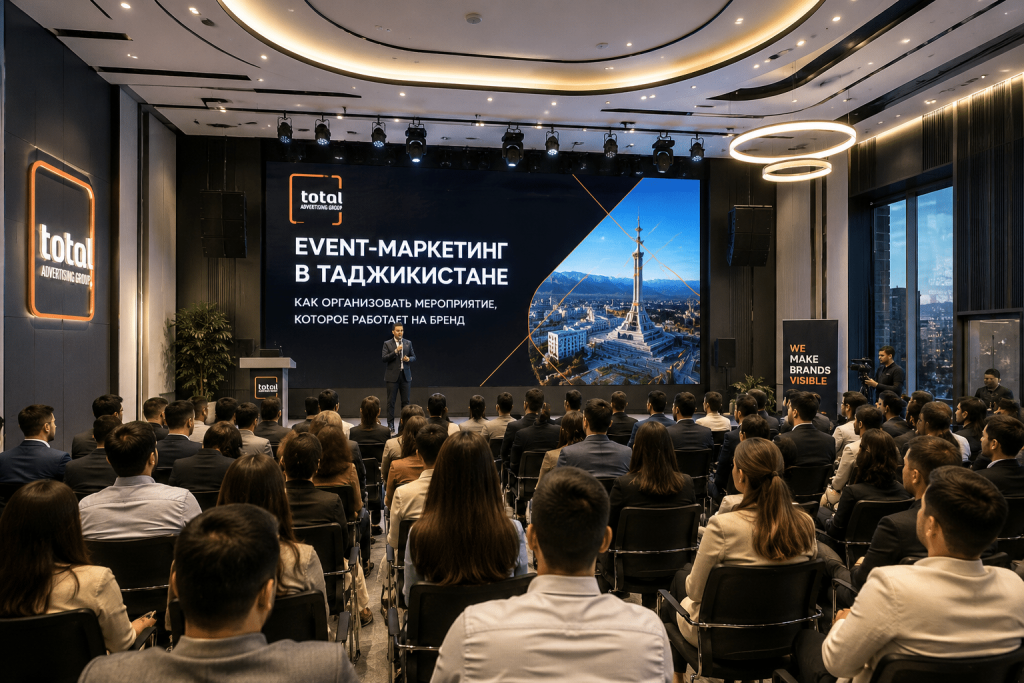
A beautiful venue, a host, music, a full hall and hundreds of photos on social media. A week later the marketer opens the sales report and sees no change at all. Sound familiar? This is what happens when an event is prepared as a celebration rather than as a marketing tool. A tasting, a promotion or a product launch only benefits the business when the result is built into the plan before the venue has even been chosen.
What a live event gives you that media cannot
TV and the internet are good at telling people about a brand, but they do not let anyone touch it. At an event, a person tries the product, asks a company representative questions and can buy on the spot without putting off the decision. In Tajikistan, where people are used to trusting personal contact and recommendations, this kind of interaction is especially valuable.
Industry research on experiential marketing also indicates that personal participation strengthens trust in a brand; see, for example, the EventTrack report. For more on how preparation and technical support work, see our page on production and event management.
Five pillars of an effective event
An objective you can measure
“Hold an event” describes an action, not a task. A task is phrased differently: collect a specific number of contacts from potential customers, increase trial purchases in selected shops, introduce a new product to a narrow circle of specialists. The objective comes first; then the format, script and venue are chosen to fit it.
Place and time
The same activity under different conditions delivers completely different results. Footfall at the location, the day of the week, the hour, the season: these determine how many members of your audience you will meet, rather than just random passers-by.
Well-prepared people on site
A promoter who silently hands out leaflets and a promoter who can quickly draw someone into conversation and get them to try the product deliver incomparable results for the same cost. Briefing and a rehearsal before the start are an essential part of preparation, not a box to tick.
Capturing data as you go
If all that remains after the event is photos, the business has missed a large part of the value. The number of contacts, guests’ reactions, their questions and objections should be recorded during the event itself. Reconstructing all of this from memory the next day will not work.
Analysis afterwards
The trace of a successful event shows up in the numbers for several weeks: sales at the outlets involved, growth in followers, enquiries from people who left their contacts. Without this kind of review, you cannot tell a working tool from a pleasant get-together.
Which formats suit the local market
- Sampling and tastings. Shoppers get to know the product right in the shop. Works best for food and everyday consumer goods.
- Presentations and launches. Appropriate in B2B and premium categories, where decisions are considered and not made at once.
- Activities in shopping centres. Provide broad reach and suit mass-market brands.
- Corporate and industry events. Build reputation and business connections rather than immediate sales.
A crowd is not a measure of success
Lots of people around a promo stand does not necessarily mean lots of potential customers. A small group of guests from your target audience is more useful to the business than hundreds of passers-by who have no need for the product. That is why the audience and venue are chosen at the planning stage, not judged after the fact from photos of a crowd.
Frequently asked questions
How long does preparation take?
Even a small local event needs several weeks: agreeing venues, training the team, producing promotional materials. If the event takes place in several cities, the timeline grows accordingly.
Can the return be measured as precisely as in digital?
There will be no instant statistics like in an ad account. But measuring the result is entirely possible: compare sales at the outlets involved before and after the event, count the contacts collected and track how many of them became customers.
Is advertising support needed?
Yes. If you do not announce the event in advance on social media, online and in local media, only those who happen to be nearby will learn about it. Announcements and media support noticeably increase the effect compared with an event held in silence.
How we can help
SKY Central Asia handles production and BTL activations: from setting the objective and choosing the venue to the promoters’ work and the final report. If you are planning an event and want it to deliver results, not just beautiful pictures, write to us and we will discuss your task.

Leave a comment