
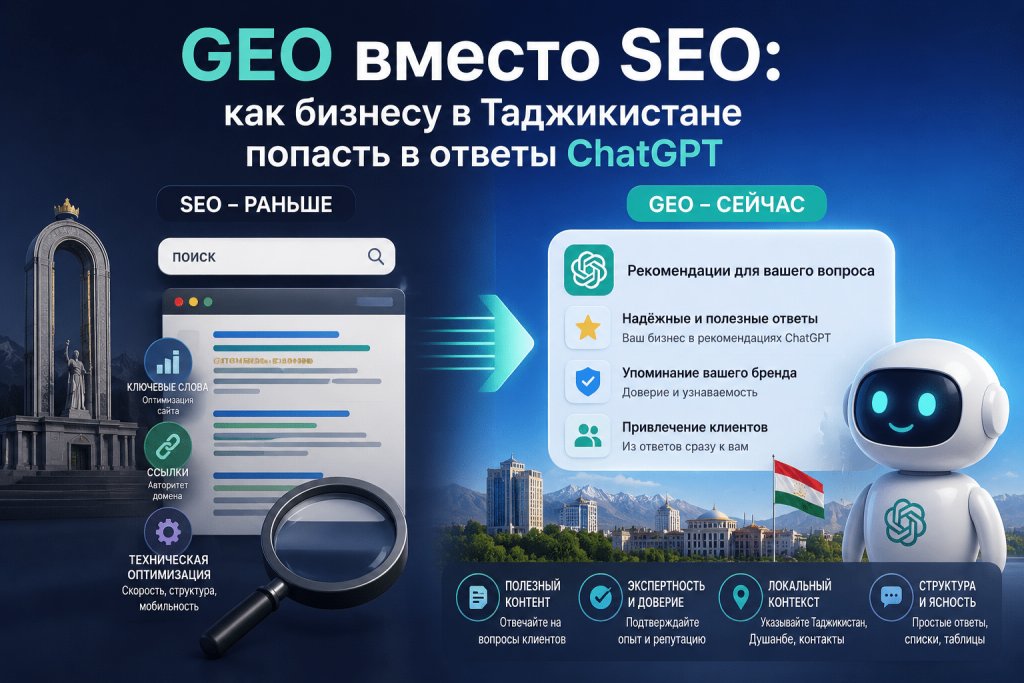
Imagine someone looking for a flat renovation contractor in Dushanbe. In the past they would have opened a search engine and scrolled through a dozen websites. Now, more and more often, they ask ChatGPT or Alice and get a short answer with a few company names. They may never visit a single website. If your company isn’t in that answer, you lose the customer without even knowing it.
The work of getting a brand into such answers is called GEO, Generative Engine Optimization, meaning optimisation for generative systems. Below is how it differs from search engine optimisation, why the topic is already relevant for Tajikistan and what to start with.
SEO and GEO: what’s the difference
Search engine optimisation helps a page rise in the results for the right queries. The user gets a list of links, opens a few and chooses for themselves. Generative optimisation has a different goal: for an AI assistant (ChatGPT, Claude, Google AI or Yandex Alice) to name your brand itself when it puts together an answer to a question.
The difference is significant. In classic search a person sees a wide choice and compares options. In a neural network’s answer they get an already selected short list. A company that didn’t make it onto that list simply doesn’t exist for this user.
Why this concerns the local market too
It’s easy to assume that AI search is something for Europe and the US and that Tajikistan is still far from it. But the audience here already lives on smartphones. The Communications Service under the Government of the Republic of Tajikistan reported 4.9 million mobile internet users in the country as of mid-2025.
People who until recently looked for services through acquaintances and classified ads are now used to sorting such things out online. The next step is the shift to voice and text assistants that give a ready answer straight away. Right now only a handful of local companies are deliberately working on their visibility in neural networks. That means those who start earlier have a chance to take this position without fierce competition.
Where to start: five practical steps
1. Structure your texts
Neural networks find it easier to parse and quote material with clear subheadings, lists and direct answers. They are reluctant to use long solid paragraphs with no logic or markup.
2. Add a questions and answers section
An FAQ block on the key pages of your website is a handy source for an assistant composing a detailed answer. A specific question with a specific answer works better than a vague “we are industry leaders”.
3. Rely on verifiable facts
The phrase “founded in 2008, with more than 500 projects behind us” contains data that can be checked and retold. The phrase “a reliable and creative partner” will be skipped by the model: there’s nothing concrete in it to latch onto.
4. Describe real work
Instead of abstract success stories, show what the task was, what was done and what it led to. Such materials are doubly useful: neural networks cite them, and human readers start to trust the company more.
5. Don’t block AI crawlers
Some website owners shut out neural network bots, fearing their content will be “stolen”. The result is the opposite: an assistant that can’t read your website will refer to a competitor whose site is open.
Mistakes that keep you out of AI answers
- Nothing but generalities. If a text has no figures or facts, the model simply has nothing to retell.
- Focusing on one system. Optimising only for Google without looking at how ChatGPT, Claude and Alice answer solves only half the problem.
- Quantity over quality. Dozens of superficial articles without expertise lose out to one in-depth piece with concrete data.
- Forgetting the local context. Generic advice that ignores prices, legislation and the specifics of Tajikistan gets cited less often and brings in fewer customers than material written for a local audience.
Questions and answers
Is it time to give up on SEO?
No, the two complement each other. SEO still brings visitors from ordinary search, GEO from conversations with assistants. Many of their principles are shared: structure, expertise and specifics help in both cases.
How can I check whether a neural network knows about my company?
Ask the assistant a question the way your customer would phrase it, for example “which advertising agency should I choose in Dushanbe” or “who does branding in Tajikistan”. See whom the system names, and repeat the check in several services.
When can I expect results?
Nobody can name exact timeframes right now: the field is young and there are no reliable statistics yet. But since GEO rests on the same principles as quality content marketing, well-structured materials with facts can start working relatively quickly.
Does a small company stand a chance?
Yes, and here the local market gives an advantage. Global brands hardly ever create content specifically for an audience in Tajikistan. A company that regularly publishes useful materials about local specifics can become the neural network’s main source for local queries.
Next step
If you want to find out whether AI assistants can see your business and prepare your website for the new type of search, request a GEO visibility audit from SKY Central Asia. Work on content and website structure is part of our websites and SEO practice, and the full list of what we do is in the agency services section.


Leave a comment